
Welcome back to the final article discussing the specific card choices when building a cube - today we are looking at the Battlefields
Drafting Battlefields
As mentioned in the first article, battlefields are not included in the packs with other Main Deck cards, as in booster draft. Instead they are drafted in the middle, between packs 2 and 3 like so:
Draft Phase:
- Each Player opens their first pack - draft 1 card and passes it to their left. Continue this process until all 11 cards have been drafted
- Repeat for the second pack - this time passing to the right
- BATTLEFIELD DRAFT - deal out 5 random battlefields face-down to each player. Like a mini-pack, each player picks 1 battlefield and passes to the left, until all players have drafted 5 battlefields.
- Open the third pack - passing again to the left
- Fourth and final pack - passing to the right
The reason I chose to do it this way is because in booster draft, it feels bad to pick a battlefield. It's hard to weigh the value of a main deck card against a random battlefield, and often players end up with less than 3. I really don’t like the idea of “blank battlefields” in Limited, so I wanted a system where players always got 5 battlefields, and could pick the best 3 for their deck. I don’t allow for blank battlefields in our cube drafts, but that’s just a design preference.
In the earliest versions of the cube, we tried drafting all the battlefields face-up, as in, putting out 8 at a time and rolling for priority on the choice. This is a deeper, more skillful way to do it, but honestly it took way too long. Players wanted to read every battlefield, hemmed and hawed over each choice. It dragged out the drafting process, and given that we usually play Best-of-1 games the battlefields are not in the player’s control anyhow. Maybe when there is a Cube Draft World Championship this would be a better approach.
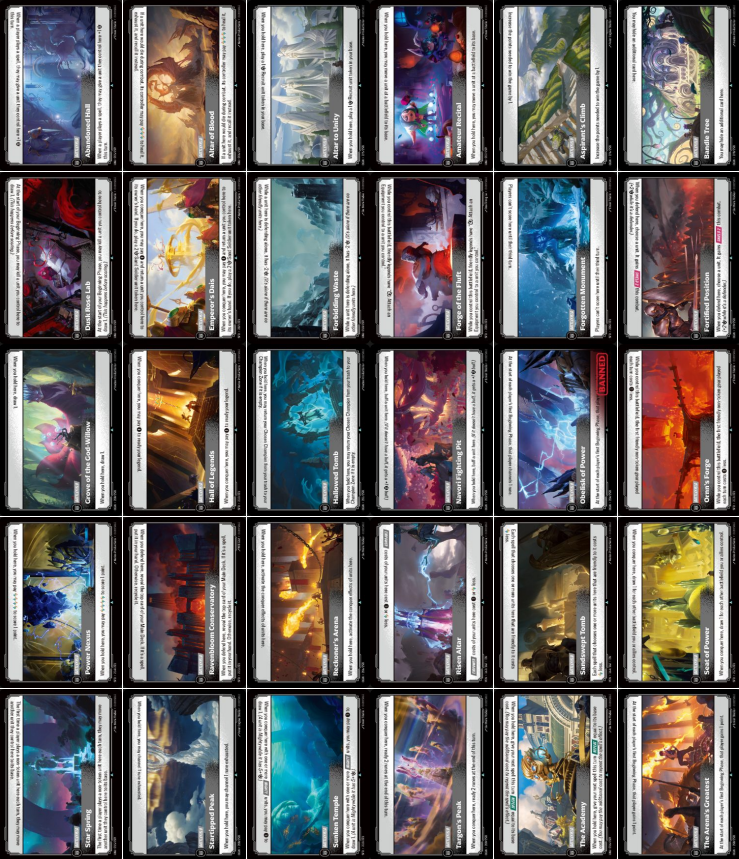
Battlefields - 40
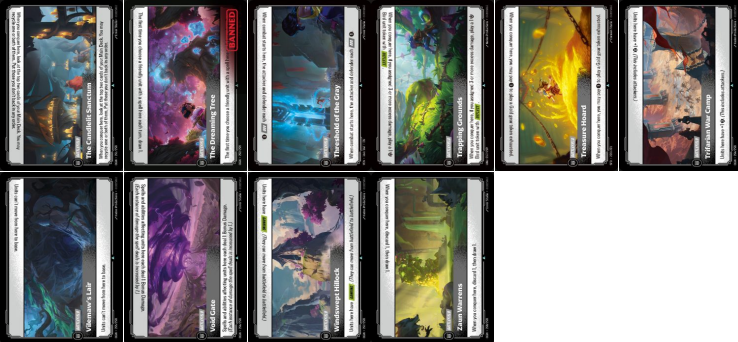
Hold Battlefields
The hardest thing to do in Riftbound is hold a battlefield, so I wanted a few big payoffs if you manage to do so. and are no-brainers that can win a game on their own, but other rarely seen in Constructed like , or can surprise you with excellent value over the course of a grindy game. and are less impressive, but I wanted enough “hold” triggers that a drafter could find 2-3 and make their random battlefield reliably support their gameplan.
While not rewarding you for holding, , and make it easier to invest heavily into defending your turf.
Conquer Battlefields
The common type of trigger, I wanted several battlefields that improve the quality of games. , , , and improve the card/rune economy of the game and let players have high intensity back-and-forth exchanges without running out of resources. Games that are decided by topdecking feel bad, so these battlefields are meant to prevent that as much as possible.
creates very unique games with or in your deck, while and reward you for playing big units. feels great when you have an exhaustable Legend and your opponent doesn’t, a feel-good reward for clever drafting.
Utility Battlefields
I tried to include any Battlefields that reduce costs and get the game into the exciting mid-turns easier. , , and means more cards are being played, which leads to more satisfying games.
Battlefields that support niche strategies are also important - and help out the gear-centric decks and often get passed a few times until they end up in the right hands. and also reward very specific deck archetypes.
For control decks, , , and help slow down the game, while Windswept Heath and speed it up through double-conquer turns.
is right on the line for me - games are already pretty fast. Still, it is neutral for both players and in Bo1 you can’t control who goes first. I considered cutting it but the 41st and 42nd “best” battlefields don’t excite players much either. If you don’t want to run it, or are probably what I would replace it with.
Notable Exclusions
While I did include nearly all battlefields banned in Constructed, I opted to leave out . The gameplay experience here is pretty awful, with both players avoiding any combat they might possibly lose.
I excluded battlefields that increase the cost of playing the game - , , and have their role in Constructed, but here I felt they mostly punished players at random and made already tight rune economies near unplayable.
Beyond that, 40 seems to be the perfect number for now - each player gets 5 battlefields to pick from, and you can usually find 3 that feel advantageous for you. The quality level drops off pretty significantly after these 40, but as more sets are released I would keep improving the choices and maybe even expand to 6 battlefields per player by the time Legacy is released.
That concludes the overview of the 40 Battlefields cards in my cube list - and wraps up the article series altogether! Thank you for joining me in this novella-length series, but I hope you can feel the passion we have at Magma Chamber for cube drafting. It is the most fun, deepest, most replayable way to enjoy Riftbound. If you have an active local community, building a Cube for them to play is an act of service that puts smiles on faces, and pays dividends for the future.
Riftbound has a long future ahead of it, but a beloved cube will always outlast the game itself - you will be able to cube draft Riftbound in the year 2100, long after sets cease to be printed, if that ever happens!