Welcome to Building the Cube - an article series on Cube Drafting, the deepest and most rewarding way to play draft in any card game. This is the first of a ten-part (yes, really) series on how to build, draft, and play games with a Riftbound Cube. This should be interesting to anyone who has ever drafted, even if you do not plan to make your own Cube. But after reading nearly 20,000+ words (yes, really) on this amazing format, hopefully the temptation will overcome your better judgment and you will join the cube community in Riftbound. Let’s get started!
What Is A Cube?
“Cube” can be a confusing term, it originated from Magic: the Gathering back in the 90s. It refers to a collection of cards, kept together in matching sleeves, for the purpose of drafting. Instead of using sealed booster packs (and keeping the cards you open), these cards are pulled out, shuffled, drafted, played, then returned to the box to be used over and over. The word “cube” doesn’t refer to anything cube-shaped, though coincidentally I keep mine in a cube-y box:
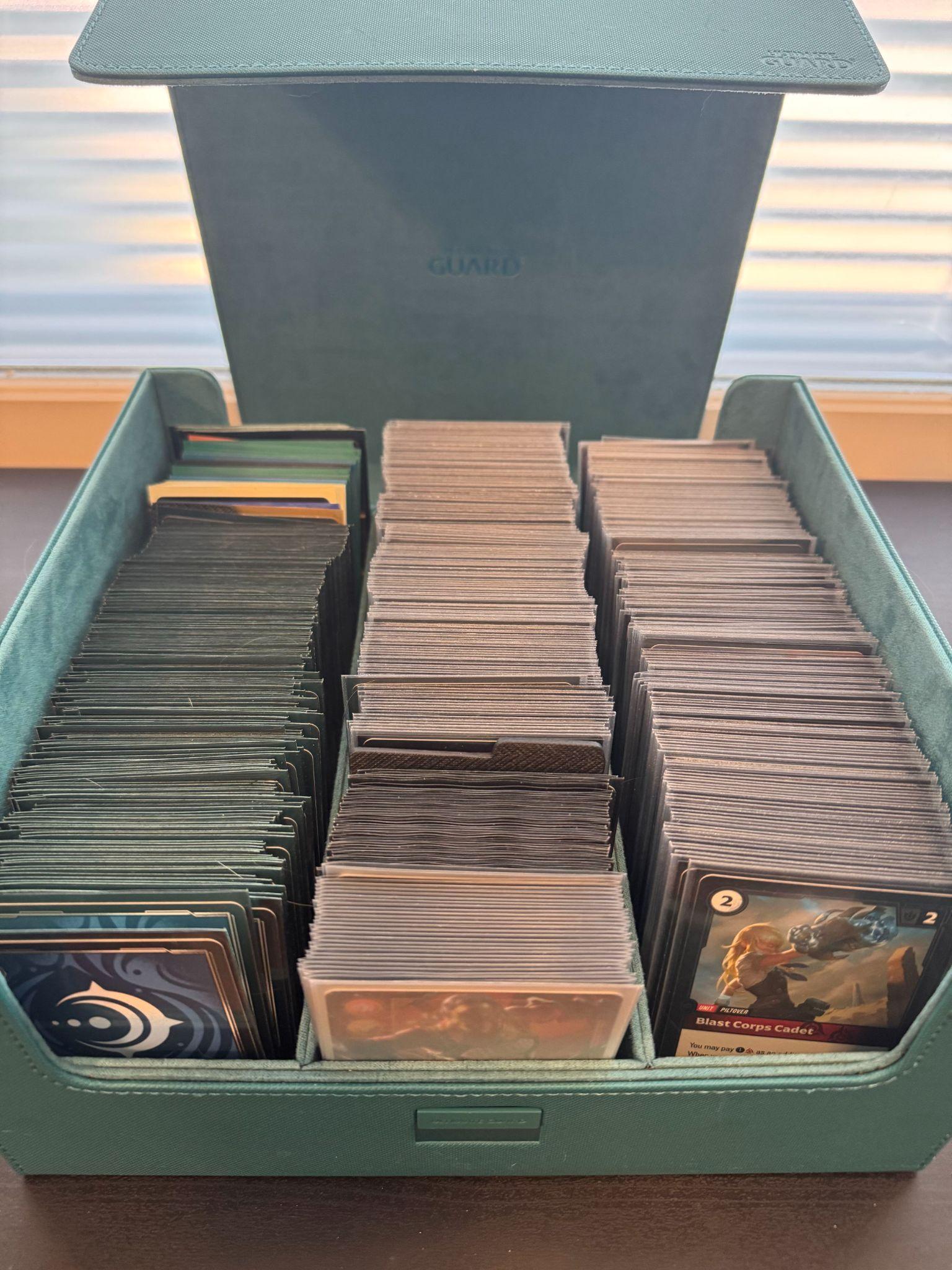
This box contains 27 Legends, 40 Battlefields, and 357 unique draftable Main Deck cards - no card appears more than once. I even sleeved up runes and tokens! When we run a cube draft locally, all players need to bring is a playmat and a desire to draft incredibly powerful and memorable decks. Due to the extreme volatility of drafting from hundreds of singleton cards, no two cube drafts will ever be the same. If we drafted every day until the heat death of the universe you would never draft the same deck twice.
Cubes are beloved by game designers of all stripes. It is the closest thing players can get to designing their own set - you choose what goes in, what is kept out, how the domains play in practice. Hate ? Cut it! Love counterspells? You are a monster, but you can include as many as you want. I even included some (but not all) banned cards in my list - from to . Everything is up to the cube designer, including how many total cards are in the box.
This article series covers my personal cube - you can find the full updated list on Magma Chamber anytime if you want to see where I ended up. Each article will cover what I am trying to accomplish with my card inclusions, why cards got left out, and my thoughts to help guide you in building your own cube.
How To Draft
Normally, Riftbound draft follows a procedure that is based on sealed booster packs. Many of the rules and conditions are based upon the fact that all possible cards can appear in a booster. You can read the official Draft Rules here - but notably a cube designer does not need to follow the exact rules, and I have not in mine. I wanted to ensure players received enough Legends and Battlefields to avoid situations where they opted to not play a Legend or used blank battlefields, but I also did not want players to be forced to pick them during the draft stage.
My Legends and Battlefields are in different sleeves from each other and the Main Deck, and players receive them separately during the draft stages. This ensures every player receives 3 Legends and 5 Battlefields, entirely separate from the 44 Main Decks cards they will draft. Then players will build an exactly 25-card deck with up to 3 domains (like Sealed). Because the card quality is so high in the cube, you often struggle to cut cards, instead of in a booster draft with so many awkward or low power filler cards.
Preparation:
- Shuffle up Legends, set them aside
- Shuffle up Battlefields, set them aside
- Shuffle up the 357 Main deck cards (everyone can contribute to this, it takes a while)
- Deal out 32 packs of 11 cards each, give each player 4 packs
- Note this is all face-down, players cannot look at any of the packs until you “open” them during the draft phase
- This leaves 5 unused Main Deck cards, return them to the box
- Deal out 3 random Legends face-down to each player. The players can see their own Legends but not anyone else’s. This gives players guidance on what they could possibly draft, without forcing them down any specific path. With 27 Legends, this should leave 3 extras - return them to the box.
Draft Phase:
- Each Player opens their first pack - draft 1 card and passes it to their left. Continue this process until all 11 cards have been drafted
- Repeat for the second pack - this time passing to the right
- BATTLEFIELD DRAFT - deal out 5 random battlefields face-down to each player. Like a mini-pack, each player picks 1 battlefield and passes to the left, until all players have drafted 5 battlefields.
- Open the third pack - passing again to the left
- Fourth and final pack - passing to the right
(note: these numbers all assume you have the full 8 players - you can absolutely draft with only 4 or 6, you will just end up with extra cards that can be returned to the box)
Players now have 44 Main Deck cards to cut down to 25 for their deck - including their Chosen Champion. With the ability to play 3 domains, players can include ANY Signature card that is within their 3 domains, and like other Limited formats, any Champion Unit can be your chosen champion. Players can use any of the 3 Legends they received, and 3 of the 5 Battlefields. We tend to play 4-5 rounds of Best-of-1, although you can also play 3 rounds of Best-of-3. We have found that Cube games are very mentally taxing (for example, that Hidden card could be anything), so it is difficult to complete 3 games in an hour. Also, it is more fun to play against more people and see what they built - it is as much of a social experience as a competition. Here is an example of a sample Cube Draft deck:
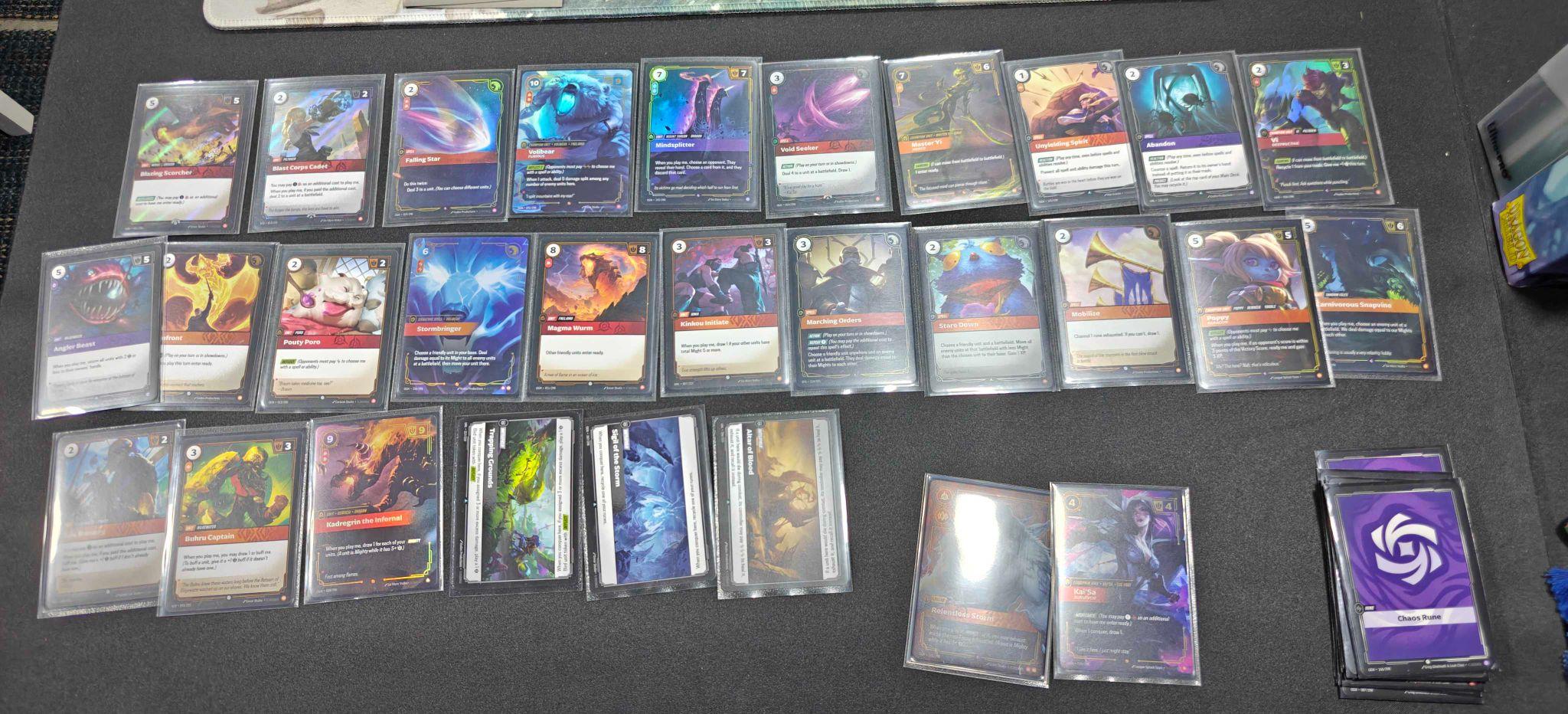
With this player having Volibear Legend before the draft began, they comfortably took Mighty units and built a quite synergistic deck, splashing Chaos for , , and to protect all those beefcakes. His first pick in the first pack (“p1p1” in draft terms) was , giving Volibear an awesome Chosen Champion to rely on in the early game. This isn’t the most powerful deck ever drafted, but it shows you how varied a Cube Draft can be.
That concludes our introduction to Cube Drafting - check out the list on Magma Chamber while you read along with the other articles for a deeper understanding of why I chose certain cards, the ratio of different energy and power costs, and even the cards I cut!